

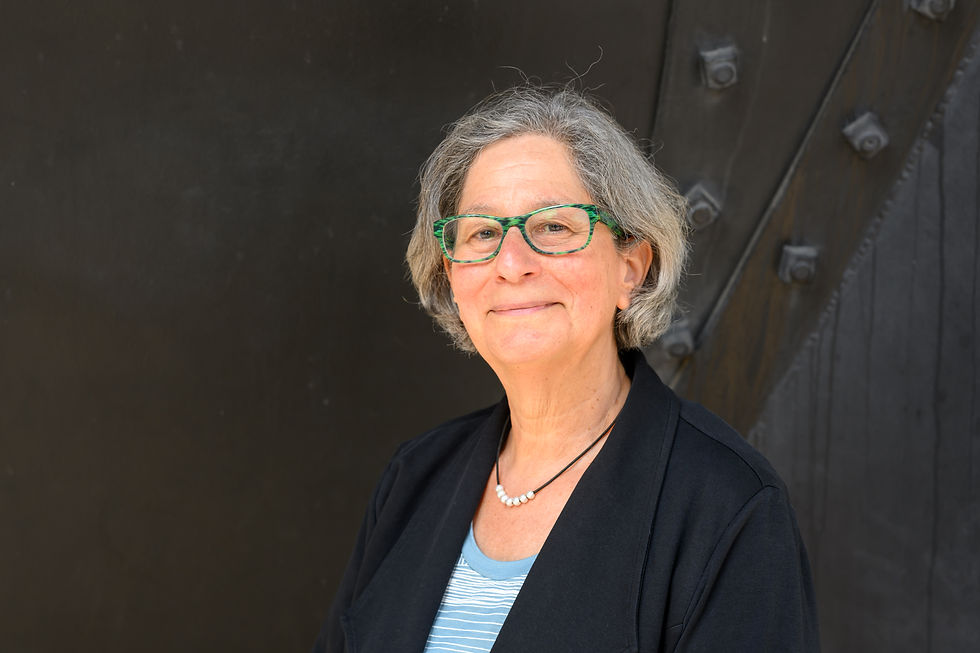
The Future of Life Award, awarded to Susan Solomon
By Future of Life | EAPS - Link to story

Celebrating the contributions of Joseph Farman, Susan Solomon and Stephen Andersen for helping save our ozone layer
On 16 September 1987, humanity took its first step towards saving the ozone layer, and thereby avoiding a climate catastrophe, by signing the Montreal Protocol. The 2021 Future of Life Award goes to Stephen Andersen, Susan Solomon, and the late Joseph Farman for their critical contributions to the most successful international environmental treaty to date.
Dr. Jim Hansen, former Director of the NASA Goddard Institute for Space Studies and Director of Columbia University’s Program on Climate Science, Awareness and Solutions said, “In Farman, Solomon and Andersen we see the tremendous impact individuals can have not only on the course of human history, but on the course of our planet’s history. My hope is that others like them will emerge in today’s battle against climate change.” In addition to preventing millions of excess skin cancer deaths, ecosystem collapse and climate change, this treaty showed that international collaboration can overcome environmental challenges without sacrificing economic prosperity. As Professor Brian Greene of Columbia University said, “the 2021 Future of Life award winners show how science can work for the betterment of humanity”.
High above our clouds, Earth’s ozone layer protects us from the Sun’s harmful ultraviolet radiation. In 1985, Joseph Farman and his team from the British Antarctic Survey made the most important geophysical discovery of the 20th century: an ozone hole above Antarctica. This provided a stunning confirmation of the Rowland-Molina hypothesis that human-made chlorofluorocarbons (CFCs) were destroying the ozone layer, and much faster than predicted, which galvanized efforts to do something about it.
In 1986-87, Susan Solomon led an Antarctic ozone research expedition. Her work confirmed that CFCs were causing ozone depletion and determined that sunlit cloudtops were catalysing additional ozone-destroying reactions, thereby speeding up the rate of depletion. In the years that followed, both Farman and Solomon became effective public advocates for the development of the Montreal Protocol that their scientific work inspired. Professor Guus Velders, a climate scientist at Utrecht University said, “Susan Solomon is a deserving recipient of the Future of Life Award. Susan not only explained the processes behind the formation of the ozone hole, she also played an active role as an interface between the science and policy of the Montreal Protocol.” MIT President L. Rafael Reif added: “All of us at MIT congratulate Susan Solomon on her Future of Life Award, in recognition of all she did to save the ozone layer – and thereby save civilization as we know it. Her pioneering research and advocacy for the Montreal Protocol stand as a model for how the world can face hard facts and collaborate creatively to tackle the global climate crisis.”
With the signing of the Montreal Protocol in 1987, the hard work of phasing CFCs out of 240 industrial sectors began. Working at the Environmental Protection Agency (EPA), Stephen Andersen founded and from 1988 to 2012 co-chaired the Technology and Economic Assessment Panel (TEAP) for the Montreal Protocol. Andersen’s tireless efforts brought together leaders from industry, government and the scientific community to develop new, CFC-free technologies. His efforts played a critical role in making the Montreal Protocol a success. Professor Ted Parson from the UCLA Emmett Institute on Climate Change and the Environment said, “For over a decade, Andersen brilliantly led the Montreal Protocol’s Technology and Economic Assessment Panel process. Andersen made the Montreal Protocol happen.” Emphasizing the importance of the Montreal Protocol, Astronomer Royal Martin Rees added, “In the face of threats to humanity’s future, we need to be think globally, rationally and long-term, empowered by technology. The story and success of the Montreal Protocol shows us that this is possible.”
Our thanks go out to Jenny Kjellgren and Justin Ihlein for nominating our winners!


Comments